

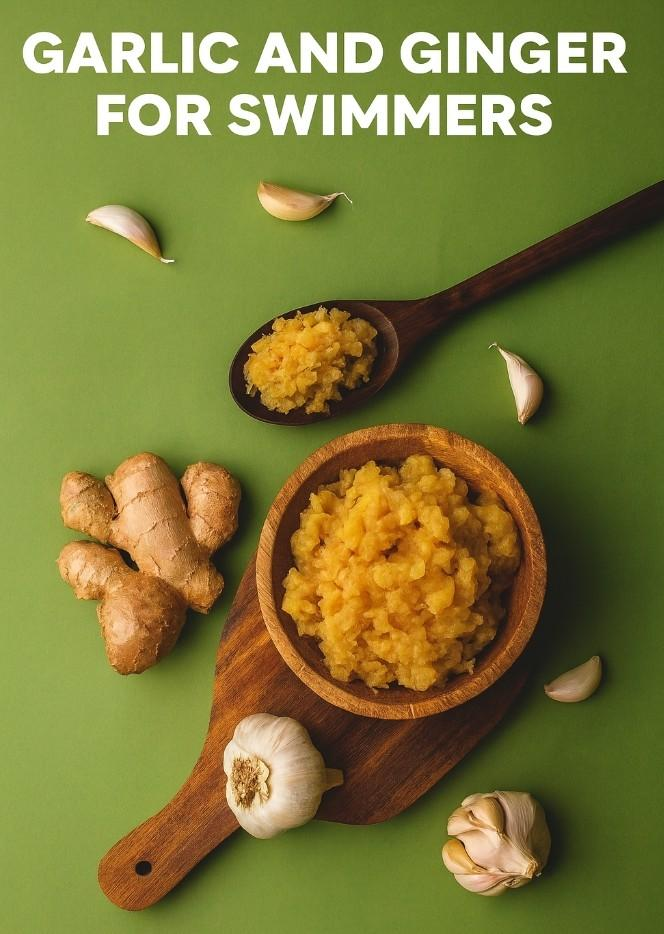
Swimmers often train hard, get cold frequently, andspend hours in a humid pool environment – all of which can weaken the immunesystem. Two simple foods, garlic and ginger, have been shown in scientificstudies to help support immunity and reduce inflammation. Garlic may helpreduce how severe colds feel and improve recovery from intense training. Gingercan help manage inflammation, ease muscle soreness, and support overallwellness.
This article explains why garlic and gingerwork, how much swimmers need, and includes an example meal and drink(ginger extraction and lemon–ginger tea) that give around 50% of the levelsused in research. The aim isn’t to replace supplements but to give swimmers asafe, natural way to support consistency in training and recovery.
Swimmers put their bodies under constant stress. Coldwater, double sessions, gym work, chlorine exposure, and early starts allcombine to challenge the immune system. While there is no magic food, garlicand ginger offer two affordable, accessible ways to strengthen immunity andimprove recovery over a long season.
Aged garlic extract (AGE) has been studied for itsimpact on the immune system. Research shows that garlic can increase theactivity of natural killer (NK) cells and γδ-T cells – immune cells involved infighting infection. In a 90-day randomised trial, adults taking aged garlicextract had fewer and less severe cold and flu symptoms than those taking aplacebo (Nantz et al., 2012; Percival, 2016).
For athletes, the benefit extends beyond infection. Arecent study on cyclists found that four weeks of garlic supplementationreduced oxidative stress and muscle damage following a 40 km time trial (Tsaoet al., 2023). While garlic didn’t make them faster, it helped their bodiescope better with intense training loads – which is exactly what swimmers needwhen preparing for competitions.
Ginger is best known for its anti-inflammatoryproperties. Systematic reviews and meta-analyses show that ginger reducesmarkers such as CRP and TNF-α, indicating lower systemic inflammation (Jalaliet al., 2020; Morvaridzadeh et al., 2020).
Exercise studies also show useful effects. One trialusing around 4 g/day ginger powder found faster recovery of muscle strengthafter intense exercise (Matsumura et al., 2015). Another study in runners foundthat ginger reduced muscle soreness after a long-distance session (Wilson,2020).
For swimmers, this can mean fewer aches betweensessions and smoother recovery during heavy training periods.
Most studies use supplements, so food amounts will beapproximate. However, swimmers can still benefit by consuming 50% of thetypical research range through meals and drinks.
2.5–3.6 g/day aged garlic extract for6–12 weeks
(Nantz et al., 2012; Percival, 2016)
2–4 g/day ginger powder or equivalent freshginger
(Jalali et al., 2020; Matsumura et al.,2015)
Parents can easily reach half of this through homemademeals and drinks.
This covers about half of typical effective dailyintake when spread across the day.
A simple extraction boosts ginger’s potency and iseasy for swimmers to drink after training.
Ingredients:
Method:
Add lemon and honey.
Provides:
~5–8 g ginger extract
(About half of what is used ininflammation studies)
Perfect for morning or evening training:
This gives 20–30% of the research range percup. Two cups per day = ~50–60%.
For younger swimmers, this is an easy, gentle way tosupport immunity.
Garlic and ginger are safe for most swimmers wheneaten as food.
Avoid very high supplemental doses ifyour child:
Always check with a healthcareprofessional if unsure.
Garlic and ginger are simple, powerful nutritionaltools. They’re not replacements for good sleep, hydration, or trainingstructure, but they offer meaningful support for immunity, inflammationcontrol, and recovery – three areas that matter greatly for young swimmers.
Using them consistently through meals and homemadedrinks can help swimmers stay healthier through heavy training blocks andperform better across the season.
Jalali, M. et al. (2020) ‘The effects of gingersupplementation on markers of inflammation and oxidative stress: a systematicreview and meta-analysis of clinical trials’, Journal of Herbal Medicine,22, 100344.
Matsumura, M.D. et al. (2015) ‘The effects ofpre-exercise ginger supplementation on muscle damage and recovery’, PhytotherapyResearch.
Morvaridzadeh, M. et al. (2020) ‘Effect of ginger oninflammatory markers: a systematic review and meta-analysis of randomizedcontrolled trials’, Clinical Nutrition, 39(3), pp. 765–775.
Nantz, M.P. et al. (2012) ‘Supplementation with agedgarlic extract improves NK and γδ-T cell function and reduces the severity ofcold and flu symptoms’, Clinical Nutrition, 31(3), pp. 337–344.
Percival, S.S. (2016) ‘Aged garlic extract modifieshuman immunity’, Journal of Nutrition, 146(2), pp. 433S–436S.
Tsao, J.P. et al. (2023) ‘Garlic supplementationattenuates cycling exercise-induced oxidative inflammation but fails to improvetime trial performance’, Journal of the International Society of SportsNutrition, 20(1), p. 42.
Wilson, P.B. (2020) ‘A randomized double-blind trialof ginger root for reducing muscle soreness and improving physical performancerecovery among experienced recreational distance runners’, Journal ofDietary Supplements, 17(2), pp. 121–132.
.png)